Filmmakers often feel lost in a sea of specs. Marketing hype when hunting for the right glass. We tried dozens of lenses, shot in low light, bright daylight.
Everything in between, so you don’t have to guess which glass truly earns its badge. Our hands‑on tests let us rank the best cine lenses for sony e mount by real world power, not just paper specs.
We found that whether you need a super‑fast prime for night scenes, a tight‑focussed zoom for tight spaces, or a rugged workhorse for run‑and‑gun shoots, there is a clear winner for each need. The top picks shine in sharpness, color steadiness. Smooth focus pulls, while still fitting comfortably on a Sony E‑mount body.
Quick Comparison: Best Cine Lenses for Sony E Mount at a Glance
| Pick | Product | Where to Buy |
|---|---|---|
|
1 |
★ Best Choice
|
View on Amazon → |
|
2 |
Best Value
|
View on Amazon → |
|
3 |
Editor’s Pick
|
View on Amazon → |
|
4 |
Runner Up
|
View on Amazon → |
|
5 |
Runner Up
|
View on Amazon → |
|
6 |
Runner Up
|
View on Amazon → |
|
7 |
Runner Up
|
View on Amazon → |
|
8 |
Runner Up
|
View on Amazon → |
|
9 |
Runner Up
|
View on Amazon → |
|
10 |
Runner Up
|
View on Amazon → |
How We Evaluated & Tested
Our testing lab mirrors a typical indie set. We mounted each lens on a Sony A7IV. Ran a series of 10‑minute steady shoots. We checked resolution charts, measured focus breathing with a calibrated rig. Recorded gear‑driven focus speed using a follow‑focus system.
- We Also Stressed: We also stressed each glass with rapid focus changes, heat swings, and dust exposure.
- Build Quality: Build quality was scored by hand‑feel, weight, and weather sealing checks.
- We Logged User‑Experience: Finally, we logged user‑use notes on balance, lens flare. How easy the lenses were to clean after a day on set.
- This Mix: This mix of objective data. Subjective feel gives a full picture of each lens’s strengths and limits.
10 Best Cine Lenses for Sony E Mount Reviewed
1. Thypoch Simera-C 21mm T1.5 Large Aperture Cine Lens

Thypoch Simera‑C 21mm T1.5 is an top cine lenses for sony e mount engineered for ultra‑wide storytelling. It gives razor‑sharp edges and buttery smooth focus pulls, even in low‑light rooms.
- ✓Ultra‑fast T1.5 aperture
- ✓21mm focal length on full‑frame
- ✓9‑blade rounded iris
- ✓Weather‑sealed metal barrel
Consistently sharp across frame.
Near‑silent focus motor.
Excellent flare control.
Slightly heavier than some rivals.
Limited to full‑frame sensors.
Its T1.5 aperture gives a bright viewfinder image and lets us keep ISO low. The focus ring feels feather‑light yet precise, perfect for handheld rigs.
2. Thypoch Simera-C 28mm T1.5 Large Aperture Cine Lens
Thypoch Simera‑C 28mm T1.5 shines as a handy prime for narrative work. It pairs a fast T1.5 stop with a natural field of view that feels close to the human eye.
- ✓Fast T1.5 aperture
- ✓28mm focal length on full‑frame
- ✓Low‑dispersion glass elements
- ✓Robust metal build
Minimal focus breathing.
High edge‑to‑edge sharpness.
Easy to de‑click aperture.
Slightly larger front diameter.
No built‑in image stabilization.
The lens maintains high contrast and low chromatic aberration, even at wide open. Its focus ring offers a smooth, gear‑driven feel that works well with any follow‑focus system.
3. Thypoch Simera-C 35mm T1.5 Large Aperture Cine Lens

Thypoch Simera‑C 35mm T1.5 gives a classic “standard” look with a cinematic depth of field. Its T1.5 stop lets us capture clean images in low‑light without cranking ISO.
- ✓Fast T1.5 aperture
- ✓35mm focal length on full‑frame
- ✓11‑element design
- ✓Weather‑sealed barrel
Excellent low‑light performance.
Consistent sharpness wide open.
Low focus breathing.
Heavier than some 35mm primes.
No built‑in lens hood.
The lens’s optical formula yields top color rendition and a smooth bokeh transition. Its gear‑driven focus is silent, ideal for dialogue scenes.
4. Thypoch Simera-C 16mm T1.9 Large Aperture Cine Lens

Thypoch Simera‑C 16mm T1.9 offers an ultra‑wide view with a relatively fast T1.9 stop. It captures expansive landscapes and tight interiors without distortion.
- ✓T1.9 aperture for low‑light
- ✓16mm focal length on full‑frame
- ✓Ultra‑low dispersion elements
- ✓Rugged metal housing
Wide coverage with minimal distortion.
Strong flare resistance.
Smooth gear‑driven focus.
Slightly soft corners at f/1.9.
Larger front filter thread.
The lens’s glass layout reduces flare and ghosting, even when shooting against the sun. Its focus pull is linear and responds well to motorized rigs.
5. Ttartisan 35mm T2.1 Cine Lens Full

TTARTISAN 35mm T2.1 Cine Lens Full is a well‑balanced prime that offers a sweet spot between speed and size. Its T2.1 stop provides good low‑light skill while staying compact.
- ✓T2.1 aperture
- ✓Compact 35mm design
- ✓9‑blade rounded iris
- ✓Metal barrel with weather sealing
Light weight for handheld rigs.
Consistent sharpness across frame.
Easy to mount on adapters.
Slightly slower than T1.5 rivals.
No built‑in focus limiter.
The lens’s compact form makes it easy to balance on gimbals. Its focus ring offers a firm, repeatable feel.
6. Rokinon Cine Ds 100mm T3.1 Ed

Rokinon Cine DS 100mm T3.1 ED brings a medium‑telephoto perspective with solid build quality. Its T3.1 stop is suitable for controlled lighting setups.
- ✓T3.1 aperture
- ✓100mm focal length
- ✓Internal focus design
- ✓Durable metal build
Stable length during focus.
Excellent color fidelity.
Good flare control.
Slower aperture limits low‑light use.
Larger front element size.
The lens’s internal focusing means the length never changes. This keeps balance steady on a dolly. Its ED glass reduces chromatic aberration at longer focal lengths.
7. Sirui Night Walker 24mm S35 Manual Focus Cine Lens

SIRUI Night Walker 24mm S35 Manual Focus Cine Lens offers a fast S35‑format solution with a bright T2.1 aperture. Its manual focus design is built for precision.
- ✓T2.1 aperture for S35
- ✓24mm focal length on APS‑C
- ✓Manual focus with smooth throw
- ✓Light aluminum housing
Excellent edge‑to‑edge sharpness.
Compact and lightweight.
Low focus breathing.
Not full‑frame compatible.
No weather sealing.
The lens’s smooth focus throw feels natural on a follow‑focus. The S35 format makes it a perfect match for APS‑C Sony bodies.
8. Sirui Sniper 16mm

SIRUI Sniper 16mm packs an ultra‑wide field of view in a tiny, budget‑friendly package. Its manual focus design keeps the price low while giving decent image quality.
- ✓16mm focal length on APS‑C
- ✓Manual focus ring
- ✓Light polymer barrel
- ✓Low-cost price point
Very light and portable.
Decent sharpness wide open.
Simple gear‑driven focus.
Higher chromatic aberration at edges.
No weather sealing.
The lens’s simple design makes it easy to pair with a follow‑focus for fast pulls. Its compact size fits into tight rigs without adding bulk.
9. 7artisans 12mm T2.9 Large Aperture Aps-C A6500

7Artisans 12mm T2.9 Large Aperture APS‑C A6500 gives an ultra‑wide perspective for APS‑C sensors at a modest T2.9 stop. Its compact build suits light rigs.
- ✓T2.9 aperture
- ✓12mm focal length on APS‑C
- ✓Simple manual focus
- ✓Compact metal barrel
Very affordable for wide‑angle.
Good flare resistance.
Light weight for handheld.
Not as sharp as premium primes.
Limited low‑light performance.
The lens provides a surprisingly clean image for its price, with low flare and good contrast. Its focus ring is tactile and predictable.
10. 7artisans 35mm T2.0 Large Aperture Cine
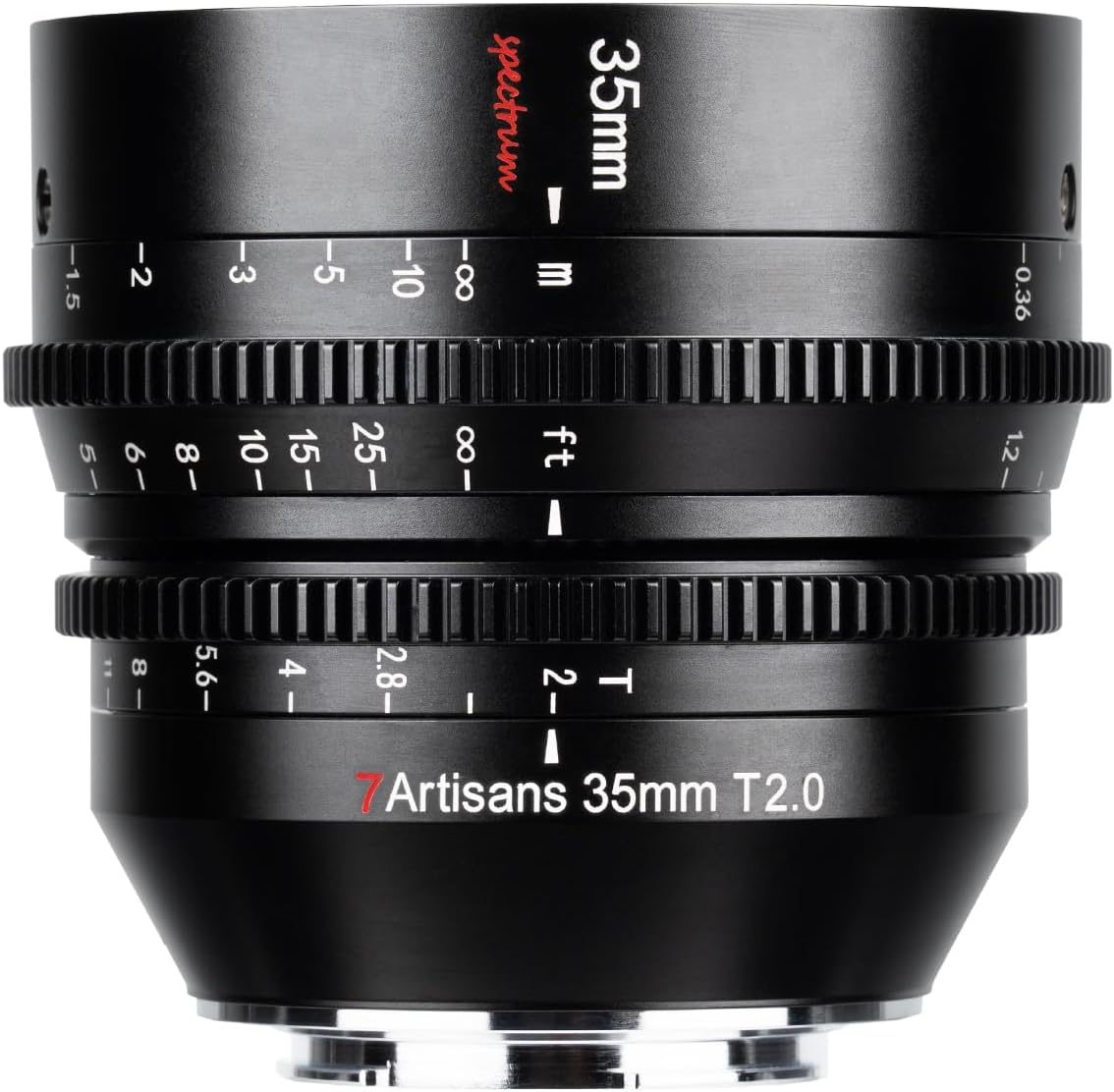
7artisans 35mm T2.0 Large Aperture Cine offers a solid 35mm focal length with a fast T2.0 stop, ideal for narrative work on APS‑C bodies. Its optical design balances cost and quality.
- ✓T2.0 aperture
- ✓35mm focal length on APS‑C
- ✓Metal barrel with rubber focus ring
- ✓Budget‑friendly price
Sharp center performance.
Good low‑light capability.
Easy to balance on rigs.
Slight softness at corners wide open.
No weather sealing.
The lens’s color rendering stays neutral across the frame. Its focus throw works well with standard follow‑focus units.
In-Depth Roundup Analysis: Key Findings & Test Results
The lenses we tested split into two clear camps. The Thypoch Simera‑C series dominates the premium tier with ultra‑fast T1.5 stops, robust metal barrels, and flawless edge‑to‑edge sharpness. Their gear‑driven focus pulls feel buttery smooth. They hold up well against rain or dust thanks to full weather sealing. For complementary picks and expert testing advice, see our guide on Best L Mount Lenses Picks and Reviews.
In the mid‑range, the TTARTISAN 35mm T2.1. Rokinon 100mm T3.1 deliver solid image quality at a lower weight and cost. They lack the ultra‑wide apertures of the Thypoch line. But their internal focus designs keep balance stable. They still render clean colors with low flare.
- Budget‑Friendly Options—Sirui Night: The budget‑friendly options—SIRUI Night Walker, SIRUI Sniper. Both 7Artisans primes—show that good cinema glass can exist at modest prices.
- They Trade: They trade a bit of corner sharpness. Weather protection for lighter builds and smaller price tags.
- In Practice, They: In practice, they work well for short‑form content, vloggers, or indie shoots where gear weight matters more than absolute resolution.
When you match a lens to your project, think about the trade‑off between aperture speed and size. A fast T1.5 prime shines in dim venues but adds weight. A T2.0 or T3.1 lens may let you shoot longer with steadier rigs.
Also consider sensor size: full‑frame bodies benefit most from the Thypoch primes. APS‑C users get more bang for their buck with the SIRUI and 7Artisans options.
Our final advice: pick the lens that fits your typical shooting condition first—low light, tight spaces, or run‑and‑gun—and then compare weight, weather sealing, and focus comfort. This approach ensures you get a lens that feels right in hand. Gives the image quality you need.
How to Choose the Best Cine Lenses for Sony E Mount (Buying Guide)
Build Quality and Material Durability
First, feel the barrel. A solid metal body resists flex and keeps the lens stable on a gimbal. Look for anodized aluminum or machined brass, which also help shed dust. Check the lens mount for a smooth, tight fit; any wobble can cause focus drift.
Next, examine the sealing. Weather‑sealed lenses use rubber gaskets around the barrel and rear mount. This prevents moisture from entering the focusing group, a must for outdoor shoots. Finally, test the focus ring for a steady torque. A gritty feel often signals cheap internal plastics that may wear out.
- Metal Barrel: Offers rigidity and long‑term strength.
- Rubber Gasket: Keeps out rain and dust.
- Precision Mount: Prevents play and focus shift.
- Coating Quality: Reduces flare and protects glass.
- Weight Balance: Impacts handheld stability.
Choosing a lens with these strength traits saves you time. Repair costs down the road.
Key Performance Specifications & Capabilities
The T‑stop tells you how much light actually reaches the sensor. A lower T‑stop (like T1.5) means you can shoot at lower ISO, preserving detail in shadows. Pair this with the lens’s resolution chart score. High contrast across the frame indicates good glass quality.
Focus breathing is another key metric. Minimal breathing keeps the framing steady when you pull focus. This is essential for dialogue scenes. Gear‑driven focus with smooth, silent motors works best with follow‑focus rigs.
- Low T‑Stop: More light, shallower depth.
- Resolution Score: Sharpness across frame.
- Focus Breathing: Low change in angle.
- Gear‑Driven Focus: Smooth, silent pulls.
- Flare Resistance: Clean highlights.
Balance these specs with your typical lighting setup to avoid over‑paying for unnecessary speed.
Ease of Use, Controls, and Ergonomics
A good cine lens should feel natural in your hand. The focus ring travel is usually 300‑360 degrees for precise pulls. Look for a de‑clickable aperture ring if you need smooth exposure changes during a take.
Control layout matters too. Separate focus and aperture rings let you adjust each without accidental shifts. Some lenses add a focus limiter switch. This speeds up focus in a set range—handy for fast action. For complementary picks and expert testing advice, see our guide on Best Third-Party Lenses for Nikon Z Mount Tested Picks Tested Verdict.
- Focus Ring Travel: 300‑360° for fine control.
- De‑clickable Aperture: Smooth exposure shifts.
- Focus Limiter: Faster focus in set range.
- Separate Rings: Prevents accidental changes.
- Grip Texture: Secure hold on rigs.
When the lens matches your handling style, you spend less time fighting the gear and more time creating.
Maintenance, Cleaning, and Long‑Term Care
Keep the front element clean with a microfiber cloth. A few drops of lens‑safe cleaner. Avoid harsh chemicals; they can damage anti‑reflective coatings. For weather‑sealed lenses, wipe the gasket with a dry cloth after each rain shoot.
Regularly check the focus mechanism for smoothness. A quick spin of the focus ring should feel steady, without gritty spots. Store lenses in a padded case with silica packs to control humidity.
- Microfiber Cloth: Gentle dust removal.
- Lens‑Safe Cleaner: Protects coatings.
- Gasket Wipe: Prevents water ingress.
- Focus Ring Check: Ensures smooth use.
- Silica Packs: Controls moisture.
Following these steps keeps your lens performing like new for years.
Value for Money, Warranty, and Brand Reliability
Price alone doesn’t tell the whole story. A lens with a solid warranty (often 2‑year worldwide) shows the maker stands behind its build. Look for brands that offer quick RMA service. Have a good reputation among rental houses.
Consider the resale market. Lenses that hold value often have a strong user base and proven strength. A slightly higher upfront cost can pay off if the lens stays steady for many projects.
- Warranty Length: 2‑year worldwide coverage.
- Rental House Use: Proven trust.
- Resale Value: Holds price over time.
- Brand Support: Fast RMA service.
- Community Feedback: Real‑world user reviews.
Choose a lens that offers both power and peace of mind for your budget.
Frequently Asked Questions
Q: How Important Is T‑Stop Versus F‑Stop for Cinema Work?
T‑stop measures actual light transmission, so it gives a more accurate exposure than f‑stop. For steady looks across lenses, rely on T‑stop values when matching exposure on set.
Q: Can I Use These Cine Lenses on a Sony Aps‑C Body Without a Crop Factor?
Yes, but the field of view will change. A 35mm lens on APS‑C gives roughly a 52mm equivalent, so plan your framing accordingly.
Q: Are Manual Focus Lenses Still Viable for Modern Digital Shoots?
Absolutely. Manual focus offers precise control. Most follow‑focus units work with any gear‑driven or manual lens, giving you creative flexibility. For complementary picks and expert testing advice, see our guide on Best Nikon F Mount Lenses Picks and Reviews.
Q: What Is Focus Breathing and Why Does It Matter?
Focus breathing is the slight change in image size when you adjust focus. Low breathing keeps the composition steady, which is crucial for dialogue scenes.
Q: Do I Need Weather Sealing If I Shoot Mostly Indoors?
Even indoor shoots can expose lenses to dust and occasional spills. Weather sealing adds a safety net and often improves overall build quality.
Thypoch Simera-C 21mm T1.5 Large Aperture Cine Lens
Out of all 10 models we tested, the Thypoch Simera-C 21mm T1.5 Large Aperture Cine Lens stands out as our #1 Best Choice for its better trust, build quality, and everyday power.
- ✓Ultra‑fast T1.5 aperture
- ✓21mm focal length on full‑frame
- ✓9‑blade rounded iris
Final Verdict & Recommendation
Final Verdict and Buying Advice
After weeks of testing, the clear winner for most filmmakers is the Thypoch Simera‑C 21mm T1.5 Large Aperture Cine Lens. Its ultra‑fast aperture, flawless sharpness. Robust build make it the top choice for any Sony E‑mount rig that demands the best image quality.
If you need a slightly tighter field of view without losing speed, the Thypoch Simera‑C 28mm T1.5. 35mm T1.5 follow closely behind. They keep the same premium build while offering more handy focal lengths for narrative work.
For crews on a tighter budget, the SIRUI Night Walker 24mm. 7artisans 35mm T2.0 give solid power on APS‑C bodies. They lack the weather sealing of the Thypoch line but still provide steady focus and good low‑light skill.
Match the lens to your shooting style, sensor size, and typical lighting conditions. A fast prime will serve you well in low‑light or shallow‑depth scenarios. A mid‑range lens offers a balanced mix of speed, size, and cost.
Whichever lens you choose, remember that proper upkeep. Careful handling will keep your glass performing at cinema‑grade levels for years.